Viability challenges remain according to new Hooke & MacDonald report
nstitutional investors returned strongly to Ireland’s residential market in the second half of 2025/first quarter of 2026, with some €644 million of investment, across multifamily homes/private rented sector (PRS). However, citing viability challenges, new apartment delivery remains significantly below the level required to meet Ireland’s growing housing needs, a new report has warned.
Institutional capital has returned strongly to Ireland’s residential sector, following a prolonged period of subdued activity, indicating increased investor confidence, according to the Residential Market Report 2026 from Hooke & MacDonald.
The return of institutional investors to the residential market means that, in 2025, the multifamily/PRS sector accounted for 16 per cent of total investment across all asset classes, accounting for €400 million – an increase of 74 per cent on the prior year – of the total spend of €2.44 billion. When student accommodation is included, there was €583 million of investment during the year. And this trend has increased further in 2026, with the multifamily/PRS accounting for 55 per cent of all investment turnover in Ireland – making it the strongest performing investment sector during the period.
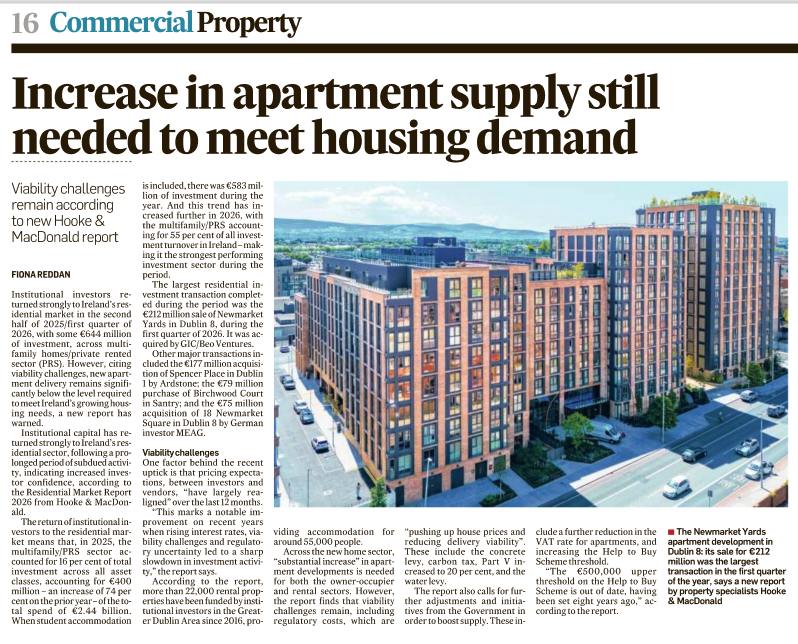
The largest residential investment transaction completed during the period was the €212 million sale of Newmarket Yards in Dublin 8, during the first quarter of 2026. It was acquired by GIC/Beo Ventures.
Other major transactions included the €177 million acquisition of Spencer Place in Dublin 1 by Ardstone; the €79 million purchase of Birchwood Court in Santry; and the €75 million acquisition of 18 Newmarket Square in Dublin 8 by German investor MEAG.
Viability challenges
One factor behind the recent uptick is that pricing expectations, between investors and vendors, “have largely realigned” over the last 12 months.
“This marks a notable improvement on recent years when rising interest rates, viability challenges and regulatory uncertainty led to a sharp slowdown in investment activity,” the report says.
According to the report, more than 22,000 rental properties have been funded by institutional investors in the Greater Dublin Area since 2016, providing accommodation for around 55,000 people.
Across the new home sector, “substantial increase” in apartment developments is needed for both the owner-occupier and rental sectors. However, the report finds that viability challenges remain, including regulatory costs, which are “pushing up house prices and reducing delivery viability”. These include the concrete levy, carbon tax, Part V increased to 20 per cent, and the water levy.
The report also calls for further adjustments and initiatives from the Government in order to boost supply. These include a further reduction in the VAT rate for apartments, and increasing the Help to Buy Scheme threshold.
“The €500,000 upper threshold on the Help to Buy Scheme is out of date, having been set eight years ago,” according to the report.
Download the full report here: https://hookemacdonald.ie/research/the-residential-market-report-2026/