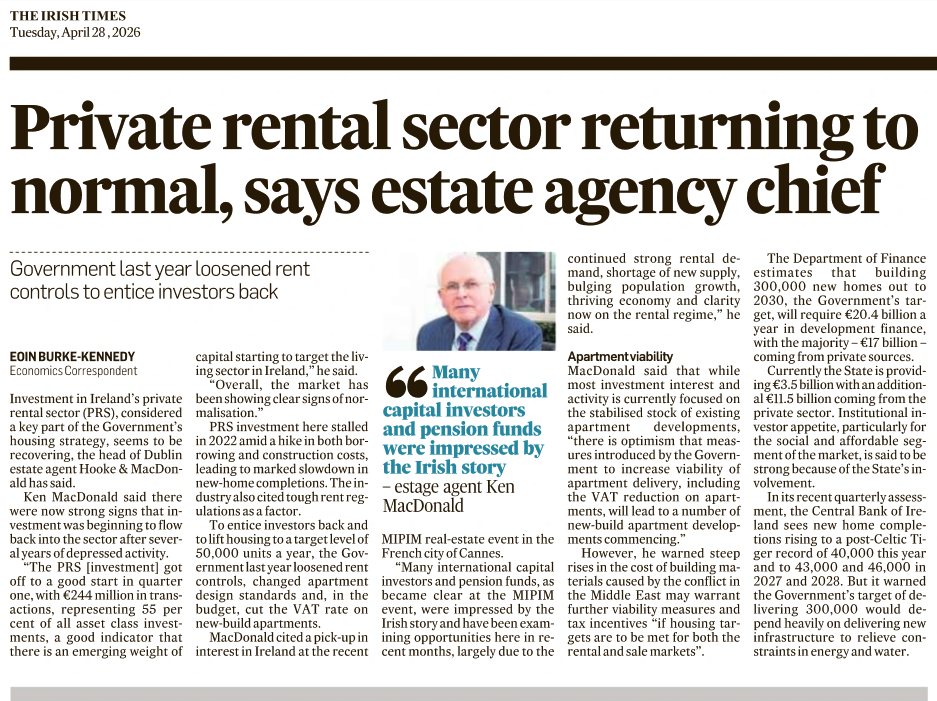
Investment in Ireland’s private rental sector (PRS), considered a key part of the Government’s housing strategy, seems to be recovering, the head of Dublin estate agent Hooke & MacDonald has said.Ken MacDonald said there were now strong signs that investment was beginning to flow back into the sector after several years of depressed activity.
“The PRS [investment] got off to a good start in quarter one, with €244 million in transactions, representing 55 per cent of all asset class investments, a good indicator that there is an emerging weight of capital starting to target the living sector in Ireland,” he said.
“Overall, the market has been showing clear signs of normalisation.”
PRS investment here stalled in 2022 amid a hike in both borrowing and construction costs, leading to marked slowdown in new-home completions. The industry also cited tough rent regulations as a factor.
To entice investors back and to lift housing to a target level of 50,000 units a year, the Government last year loosened rent controls, changed apartment design standards and, in the budget, cut the VAT rate on new-build apartments.
MacDonald cited a pick-up in interest in Ireland at the recent MIPIM real-estate event in the French city of Cannes.
“Many international capital investors and pension funds, as became clear at the MIPIM event, were impressed by the Irish story and have been examining opportunities here in recent months, largely due to the continued strong rental demand, shortage of new supply, bulging population growth, thriving economy and clarity now on the rental regime,” he said.
Apartment viability
MacDonald said that while most investment interest and activity is currently focused on the stabilised stock of existing apartment developments, “there is optimism that measures introduced by the Government to increase viability of apartment delivery, including the VAT reduction on apartments, will lead to a number of new-build apartment developments commencing.”
However, he warned steep rises in the cost of building materials caused by the conflict in the Middle East may warrant further viability measures and tax incentives “if housing targets are to be met for both the rental and sale markets”.
The Department of Finance estimates that building 300,000 new homes out to 2030, the Government’s target, will require €20.4 billion a year in development finance, with the majority – €17 billion – coming from private sources.
Currently the State is providing €3.5 billion with an additional €11.5 billion coming from the private sector. Institutional investor appetite, particularly for the social and affordable segment of the market, is said to be strong because of the State’s involvement.
In its recent quarterly assessment, the Central Bank of Ireland sees new home completions rising to a post-Celtic Tiger record of 40,000 this year and to 43,000 and 46,000 in 2027 and 2028. But it warned the Government’s target of delivering 300,000 would depend heavily on delivering new infrastructure to relieve constraints in energy and water.