After almost a year in government our policymakers have not yet come up with an energetic, viable strategy to meet this emergency
We have had a new Government in place for 11 months. From a housing policy point of view, we were promised ‘radical’ changes and ‘paradigm shift’ in the Government’s approach.
Three weeks ago, the Government announced its long-awaited housing strategy ‘Delivering Homes, Building Communities: An Action Plan on Housing Supply and Targeting Homelessness’.
It contains neither radical thinking nor provides a paradigm shift.
In fairness, the plan includes plenty of positive and well thought out initiatives. The housing sector is complex and requires a comprehensive approach.
However, there are not enough wide-ranging measures to allow Ireland to produce the stated goal of 300,000 homes by the end of 2030.
This needs to be communicated to the Government now by the property sector and understood by those politicians who still have the opportunity to make changes and foster the required new supply in the life of this Government.
The property sector as much as any stakeholder wants the Government’s strategies for housing to be a success. However, the Government and the respective departments continue to devise policies that have little input or feedback from the private sector, which delivers housing.
For example, when the recent Vat reduction was announced it only applied to ‘forward sale’ and not ‘forward fund’ transactions; or indeed the much-hyped ‘STAR’ affordable rental scheme which remains largely idle despite being available since August 2023.
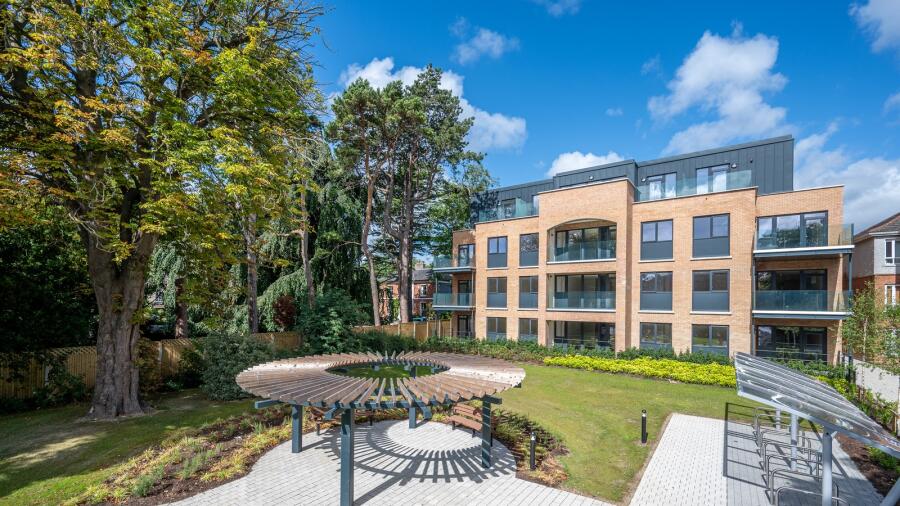
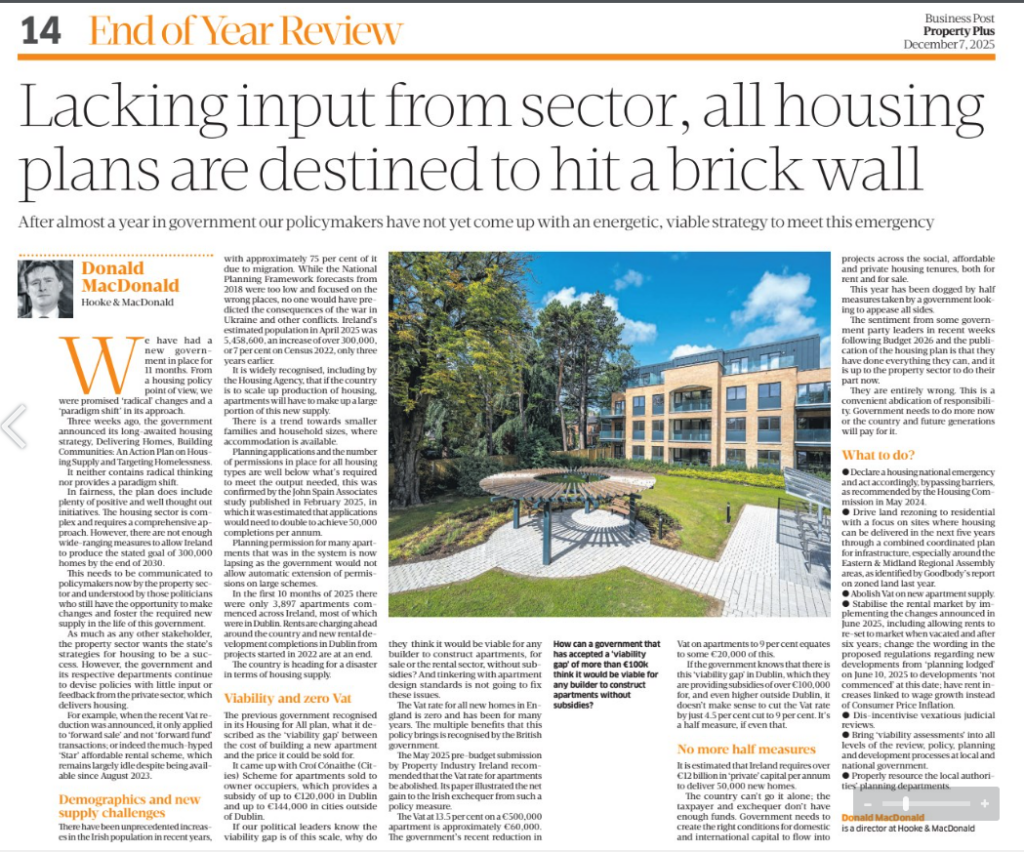
Hooke & MacDonald has seen brisk sales at Ashbrook, a newly completed Baystreet Ltd scheme of 44 apartments in three blocks on the Howth Road in Clontarf, Dublin 3
Demographics and new supply challenges
There has been unprecedented increases in the Irish population over recent years, with approximately 75 per cent of it due to migration. While the National Planning Framework forecasts from 2018 were too low and in the wrong places, no one would have predicted the consequences of the war in Ukraine and other conflicts. Ireland’s estimated population in April 2025 was 5,458,600, an increase of over 300,000, or 7 per cent on Census 2022, only three years earlier.
It is widely recognised, including by the Housing Agency, that if the country is to scale up production of housing, apartments will have to make up a large portion of this new supply.
There is a trend towards smaller families and household sizes, where accommodation is available.
Planning applications and the number of permissions in place for all housing types are well below the numbers required to meet the required output, this was confirmed by the John Spain Associates study published in February 2025, in which it was estimated that applications would need to double to achieve 50,000 completions per annum.
Many planning permissions for apartments that were in the system are now lapsing as the Government would not allow automatic extension of permissions on large schemes.
In the first ten months of 2025 there were only 3,897 apartments commenced across Ireland, most of which were in Dublin. Rents are charging ahead around the country and new rental development completions in Dublin from projects started in 2022 are at an end.
The country is heading for a disaster in terms of housing supply.
Viability and a zero Vat rate
The previous Government recognised in its ‘Housing for All’ plan, what it described as the ‘viability gap’ between the cost of building a new apartment and the price it could be sold for.
They came up with Croí Cónaithe (Cities) Scheme for apartments sold to owner occupiers, which provides a subsidy of up to €120,000 in Dublin and up to €144,000 in cities outside of Dublin.
If government knows the viability gap is of this scale, why does it think it would be viable for any builder to build apartments for sale or the rental sector without subsidies? And tinkering with apartment design standards is not going to fix these issues.
The Vat rate for all new homes in England is zero and has been for many years. The multiple benefits that that policy brings is recognised by the British government.
The May 2025 Pre-Budget Submission by Property Industry Ireland recommended that the Vat rate for apartments be reduced to zero per cent. Its paper illustrated the net gain to the Irish Exchequer from such a policy measure.
The Vat at 13.5 per cent on a €500,000 apartment is approximately €60,000. The Government’s recent reduction in Vat on apartments to 9 per cent equates to approximately €20,000.
If the Government knows that there is this ‘viability gap’ in Dublin, which they are providing subsidies of over €100,000 for, and even higher outside Dublin, it doesn’t make sense that a Vat rate is only a 4.5 per cent cut to 9 per cent. It’s a half measure, if even.
No more half measures
It is estimated that Ireland requires over €12 billion in ‘private’ capital per annum to deliver 50,000 new homes.
The country can’t go it alone; the taxpayer and Exchequer don’t have enough funds. Government needs to create the right conditions for domestic and international capital to flow into projects across the social, affordable and private housing tenures, both for rent and for sale.
This year has been dogged by half measures taken by Government looking to appease all sides.
The sentiment from some Government party leaders over recent weeks following Budget 2026 and the publication of the housing plan is that they have done everything they can, and it is up to the property sector to do their part now.
They are entirely wrong. This is a convenient abdication of responsibility. Government needs to do more now or the country and future generations will pay for it for decades to come.
What to do? Start with…
– Declaring a housing national emergency and act accordingly, bypassing barriers, as recommended by the Housing Commission in May 2024.
– Drive land re-zoning to residential with a focus on sites where housing can be delivered in the next five years through a combined coordinated plan for infrastructure, especially around the Eastern & Midland Regional Assembly areas, as identified by Goodbody’s report on zoned land last year.
– Zero rate Vat on new apartment supply.
– Stabilise the rental market by implementing the changes announced in June 2025, including allowing rents to re-set to market on vacate and after 6 years; change the wording in the proposed regulations regarding new developments from ‘planning lodged’ on June 10, 2025 to developments ‘not commenced’ at this date; have rent increases linked to wage growth instead of Consumer Price Inflation.
– Dis-incentivise vexatious Judicial Reviews.
– Bring ‘viability assessments’ into all levels of the review, policy, planning & development processes at local and national government.
– Properly resource the local authorities planning departments.
Donald MacDonald is a director of Hooke & MacDonald
Source : The Business Post