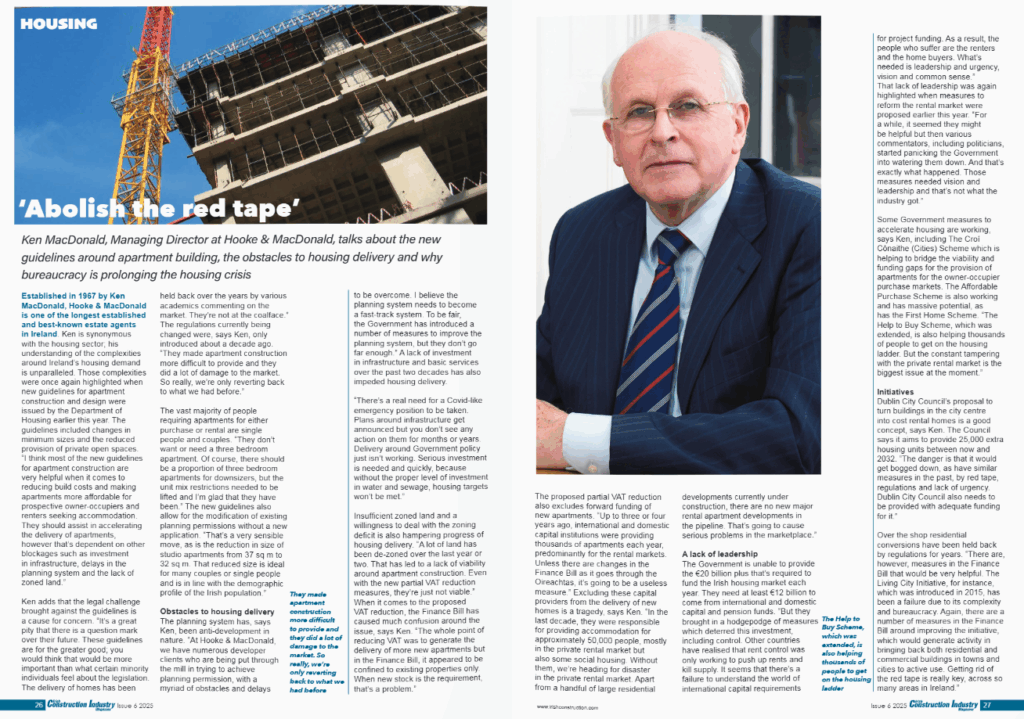
Ken MacDonald, Managing Director at Hooke & MacDonald, talks about the new guidelines around apartment building, the obstacles to housing delivery and why
bureaucracy is prolonging the housing crisis.
Established in 1967 by Ken MacDonald, Hooke & MacDonald is one of the longest established and best-known estate agents in Ireland. Ken is synonymous with the housing sector, his understanding of the complexities around Ireland’s housing demand is unparalleled. Those complexities were once again highlighted when new guidelines for apartment construction and design were issued by the Department of Housing earlier this year. The guidelines included changes in minimum sizes and the reduced provision of private open spaces “I think most of the new guidelines for apartment construction are very helpful when it comes to reducing build costs and making apartments more affordable for prospective owner occupiers and renters seeking accommodation. They should assist in accelerating the delivery of apartments, however that’s dependent on other blockages such as investment in infrastructure, delays in the planning system and the lack of zoned land.
Ken adds that the legal challenge brought against the guidelines is a cause for concern. “It’s a great pity that there is a question mark over their future. These guidelines are for the greater good; you would think that would be more important than what certain minority individuals feel about the legislation. The delivery of homes has been held back over the years by various academics commenting on the market. They’re not at the coalface.” The regulations currently being changed were, says Ken, only introduced about a decade ago. They made apartment construction more difficult to provide and they did a lot of damage to the market. So really, we’re only reverting back to what we had before.”
The vast majority of people requiring apartments for either purchase or rental are single people and couples. “They don’t want or need a three bedroom apartment. Of course, there should be a proportion of three bedroom apartments for downsizers, but the unit mix restrictions needed to be lifted and I’m glad that they have been. The new guidelines also allow for the modification of existing planning permissions without a new application. “That’s a very sensible move, as is the reduction in size of studio apartments from 37 sqm to 32 sq m. That reduced size is ideal for many couples or single people and is in line with the demographic profile of the Irish population.”
Obstacles to housing delivery
The planning system has, says Ken, been anti-development in nature. “At Hooke & MacDonald we have numerous developer clients who are being put through the mill in trying to achieve planning permission, with a myriad of obstacles and delays to be overcome. I believe the planning system needs to become a fast-track system. To be fair, the Government has introduced a number of measures to improve the planning system, but they don’t go far enough.’ A lack of investment in infrastructure and basic services over the past two decades has also
impeded housing delivery.
‘There’s a real need for a Covid-like emergency position to be taken. Plans around infrastructure get announced but you don’t see any action on them for months or years Delivery around Government policy just isn’t working. Serious investment is needed and quickly, because without the proper level of investment in water and sewage, housing targets won’t be met.”
Insufficient zoned land and a willingness to deal with the zoning deficit is also hampering progress of housing delivery. “A lot of land has been de-zoned over the last year or two. That has led to a lack of viability around apartment construction. Even with the new partial VAT reduction measures, they’re just not viable.’ When it comes to the proposed VAT reduction, the Finance Bill has caused much confusion around the issue, says Ken. “The whole point of reducing VAT was to generate the delivery of more new apartments but in the Finance Bill, it appeared to be confined to existing properties only When new stock is the requirement, that’s a problem.*
The proposed partial VAT reduction also excludes forward funding of new apartments. “Up to three or four years ago, international and domestic capital institutions were providing thousands of apartments each year, predominantly for the rental markets. Unless there are changes in the Finance Bill as it goes through the Oireachtas, it’s going to be a useless measure.” Excluding these capital providers from the delivery of new homes is a tragedy, says Ken. “In the last decade, they were responsible for providing accommodation for approximately 50,000 people, mostly in the private rental market but also some social housing. Without them, we’re heading for disaster in the private rental market. Apart from a handful of large residential developments currently under construction, there are no new major rental apartment developments in the pipeline. That’s going to cause serious problems in the marketplace.”
A lack of leadership
The Government is unable to provide the €20 billion plus that’s required to fund the Irish housing market each year. They need at least €12 billion to come from international and domestic capital and pension funds. “But they brought in a hodgepodge of measures which deterred this investment, which was including control. Other countries have realised that rent control was extended, is also helping only working to push up rents and kill supply. It seems that there’s a failure to understand the world of international capital requirements for project funding. As a result, the people who suffer are the renters and the home buyers. What’s needed is leadership and urgency, vision and common sense.” That lack of leadership was again highlighted when measures to reform the rental market were proposed earlier this year. ‘For a while, it seemed they might be helpful but then various commentators, including politicians, started panicking the Government into watering them down. And that’s exactly what happened. Those measures needed vision and leadership and that’s not what the
industry got.”
Some Govemment measures to accelerate housing are working, says Ken, including The Croi Cónaithe (Cities) Scheme which is helping to bridge the viability and funding gaps for the provision of apartments for the owner-occupier purchase markets. The Affordable Purchase Scheme is also working and has massive potential, as has the First Home Scheme. ‘The Help to Buy Scheme, which was extended, is also helping thousands of people to get on the housing ladder. But the constant tampering with the private rental market is the biggest issue at the moment.”
Initiatives
Dublin City Council’s proposal to turn buildings in the city centre into cost rental homes is a good concept, says Ken. The Council says it aims to provide 25,000 extra
housing units between now and 2032. “The danger is that it would get bogged down, as have similar measures in the past, by red tape,
regulations and lack of urgency. Dublin City Council also needs to be provided with adequate funding
for it.”
Over the shop residential conversions have been held back by regulations for years. “There are, however, measures in the Finance Bill that would be very helpful. The Living City Initiative, for instance, which was introduced in 2015, has been a failure due to its complexity and bureaucracy. Again, there are a number of measures in the Finance Bill around improving the initiative, which would generate activity in bringing back both residential and commercial buildings in towns and cities to active use. Getting rid of the red tape is really key, across so
many areas in Ireland.”